The exhibition that has just opened at the Lemmerman Gallery entitled WWII: eye of the storm is a beautiful work of artistic activism that calls for the viewer to take responsibility for each individual issue brought up by the artwork displayed. Three works popped out to me the most and caught my attention.
 |
| Video Display of Glacial Ablation |
Beginning with Gwen Charles’
Glacial Ablation, this piece takes a moment to take in fully. As you walk into the gallery the sounds emnating from this piece transfix the listener. Upon walking over to the TV and taking a closer look at the video you see layers of silver mylar and cellophone undulating as a female form moves underneath. Without looking at the video one would have guessed that the sounds were waves from the ocean or winds whipping through a forest. Ironically the materials used to replicate these sounds would typically be found poisoning and polluting these areas.
Gwen Charles creating this piece in response to articles that she had read about the
sinking
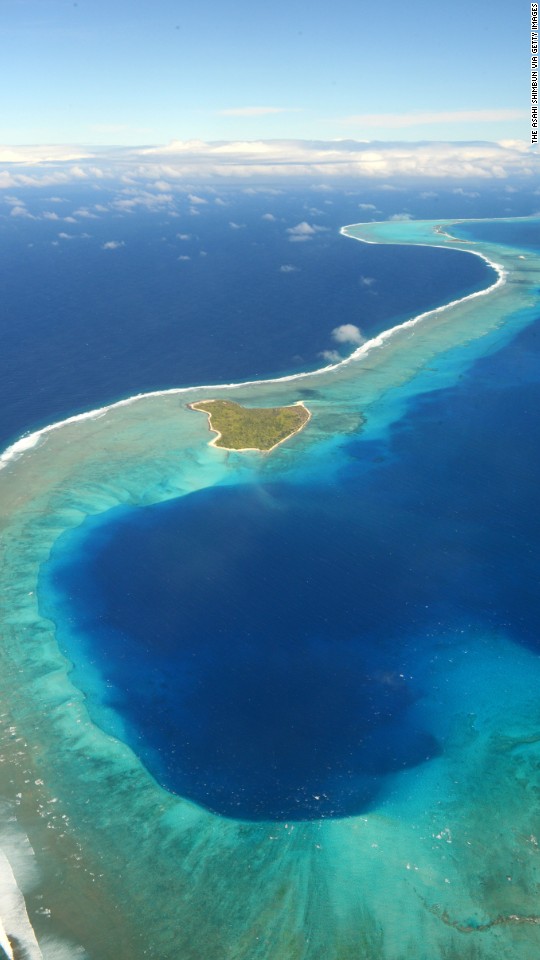 |
Coral Reef poking out along
the trail of the Marshall Islands |
Marshall Islands due to rising water levels, and the
erupting Hunga Tong-Hunga volcano that is poking through the surface of the sea to create a new island. The female form sinking and coming up for air is a metaphor for the human condition and our daily struggle to “keep afloat”. It mimics the island being created by the Hunga Tonga-Hunga volcano. This island is significant in that it is one of only 3 to survive beyond its initial bruising. Typically these formations are destroyed by violent waves before they can even form islands yet Hunga Tonga-Hunga stands. Conversely there are the Marshall Islands with a population of roughly 70,000 that will disappear entirely as a direct result of climate change caused by humans. 2 degrees is all it will take for this entire chain of islands to be swallowed up by the violent waves of the ocean. The female body also represents the Marshall Island’s struggle to stay afloat as well.
Glacial Ablation beautifully encapsulates the feelings and issues surrounding these drastic events caused by climate change and an abuse of power. Living on the Marshall Islands brings painful awareness to the effects of being neutral about the damage we are causing to the Earth. The waves are angry and no longer soothing as
 |
| Hunga Tonga-Hunga Caldera |
they once were. From mainland U.S.A. it is easy to forget and be complacent which is what the piece aims to end by grabbing the viewer’s attention and educating them on the issue at hand. This piece of art is even more powerful according to Seeing Power “We are beginning to sense that the context of a gesture—whether it is produced by a television network or by friends that we trust—lends much to its interpretation. Just as we saw with Paul Chan’s, Waiting for Godot, the implications of spectacle can be felt in everyday experiences. Everyday people are beginning to understand at a very intuitive level that power uses culture to manipulate them and, conversely, that moments that are free of that coercion are uniquely special.” (Page 116). The culture of America is to blindly consume and the companies that benefit from this use their power to keep us in this cycle. Charles’ piece is an act against this injustice like Waiting for Godot that utilizes our senses to connect us back to nature and feel the wrongdoing that is being done by blindly consuming and polluting the Earth. Gaia is a living breathing thing that reflects what we put into her and she is churning and angry. As Nato Thompson puts it, “A fish sees water no better than we see the culture industry, It is all around us, and it evelops us, but in order to see it, we must, as philosphoer Giorgio Agamben advies, think contemporarily. One way to do this is to listen carefully to teh anxieties of thsoe who witnessed the flood-before it consumed them”. (Pg. 7)
 |
| Bonding With Plastic |
The next piece that caught my attention, Olga Mercedes Bautista’s
Bonding With Plastic goes into further depth on the relationship between power and climate change. She brings our attention to this issue by meshing nature and consumerism into her artificial tree barks. These artificial pieces are made specifically with plastic and bark reclaimed from the aftermath of Hurricane Sandy. The most beautiful touch to this piece is the bits and pieces of recognizable merchant bags and stickers poking through the bark coloured bits which brings our attention to the fact that we as consumers are responsible.
 |
| Bonding With Plastic |
The accompanying photograph in which a lone piece of bark is strewn with the washed up debris on the beach really drives home and highlights the point of Bautista’s work. The article On Photography that we read at the beginning of the semester helps to highlight and understand the true power of this image, “To photograph is to appropriate the thing photographed. It means putting oneself into a certain relation to the world that feels like knowledge— and, therefore, like power.” (Paragraph 3). By placing her bark into the world like that she is creating a clear statement. As if to say we did this, or that this a direct product of our consumerism. She places this Frankenstein of consumerism and nature directly into the battlefield where the fruits of our blindness lay. She is appropriating the scene to fit her agenda which is an exertion of her power as the photographer but its educating and encouraging knowledge.
The artificial bark also brings to mind Nato Thompson’s commentary on post Ford era consumerism,”By the 1950’s Ford’s assembly line told another kind of story: each car was now composed of parts that arrived from various corners of the world.”(pg 6). The materials used in the bark are from the different aspects of climate change, those which are causing the problems and those which are effected by it. Our consumerism juxtaposed onto the nature that it destroys.
 |
Documentary scene of Magnolia
being chopped down. |
Lastly we have Tamara Gubernat’s
In my Backyard which brings the viewer into a personal reflection. Gubernat documents the loss of a magnolia tree that is very beloved to her. It sparks a journey to reclaim the soil where the magnolia tree once stood and reconnect with nature. This piece in particular feels the most accessible to the viewer. Whereas other works of art show you the problem, Tamara Gubernat shows you her solution. Not only that, but her solution is one that can be replicated by the viewer.
 |
| Image from photobook |
She connects the viewer by providing the photo book next to the documentary which gives glimpses into her journey via a different format. Empathy is evoked from the old timey photos taken with the magnolia tree. You can feel the memories and bonds felt within that lead you to empathize with the pain that Gubernat goes through in losing the tree. It evokes the feelings that I’m sure Gwen Charles must have felt reading about the disappearing Marshall islands as well. Like the Center for
 |
| Cutting from the Magnolia tree |
Land Use Interpretation,”Their work is about the lived world, and they use artistic methods to make this knowledge available.”(page 156).
Joyce Yu-Jean Lee’s artowrks echo the messages being sent by these artworks. Collectively her artowrk in her exhibition
State of DysUnion has one unified message, “While contemporary media washes over us, we can sometimes get lulled to sleep and we don’t realize what’s happening,”. (TCNJsignal.net). Just as her artowrk bring our attention to this daze that we live in on a daily basis, the artworks presented in WWII: eye of the storm do the same. Every piece in both exhibitions calls our attention to wake up from the daze which we have allowed the media to pull us into and make a change in the world even just starting with something as small as repurposing the soil that a beloved tree used to exist in.
Works Cited:
http://www.newsweek.com/hunga-tonga-new-volcanic-pacific-island-gives-nasa-glimpse-life-mars-745171
http://www.cnn.com/interactive/2015/06/opinions/sutter-two-degrees-marshall-islands/
http://www.tcnjsignal.net/2018/02/20/professor-creates-political-commentary-through-art/


No comments:
Post a Comment