 |
| Intimacy/Autonomy by Joan Semmel donated to the Brooklyn Museum. |
In 2015 Semmel took part in a panel at the Maccarone Gallery titled "Painting and the Legacy of Feminism". There are a plethora of brilliant moments and commentary that occurred that night, but the most inspiring for me was this one:
"I don't think about feminism when I'm in the studio. There I'm thinking about making that painting, and what that painting means to me and how it resonates. While I'm doing it, I'm only involved in my relationship to the work and vice versa, not to anything else. Then I want to take it out into the world, but the world has to be ready to receive it, and that's when I need my feminism. If I don't get out there and do something about it, things are going to stay the way they are. For younger women, they have exactly the same problem. No one goes into the studio saying, 'I'm a feminist, how do I make a feminist painting?' You make a painting that relates to who you are and how you function and what you're doing. If you have children, if you don't have children, if you're getting sex, if you're not...all of these things enter into it. It's about you, the work is about you. And you live in the world. If you want the world to receive you, you better damn well get out there and change it."It's quotes like these that make me feel like I can't sit still, that I need to do something to change the world around me. We only have one earth to live on and if I'm not making a constant effort to make it a better place then I'm wasting my time. In this case we live in a generation where its inexcusable the amount of discrimination that goes on not just in the art world, but the world in general. For this reason feminism is still necessary.
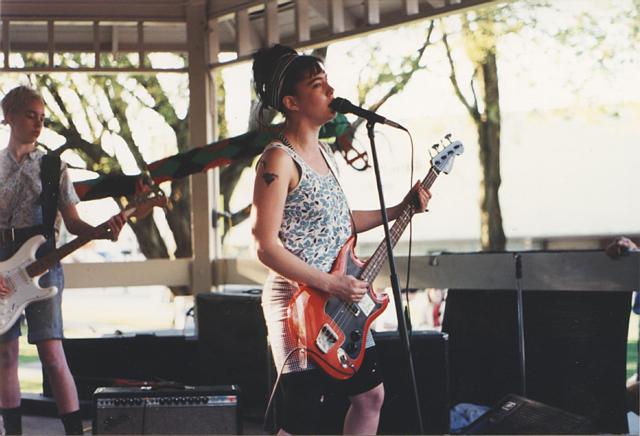 |
| Bikini Kill performing live at Sylvester Park in Olympia, Washington on May 1, 1991 (Image taken from Wikipedia) |
The pioneer of the Riot Girl movement, Bikini Kill also instills that feeling of needing to do something into their audience. Their medium of feminism is in the lyrics and zines created by them and other Riot Grrrls during the 90's. They blasted onto the punk rock scene that had been previously dominated by all boy groups. A girl's role in this scene was to be the girlfriend of these punks, until Bikini Kill arrived.
"Bikini Kill believed that if all girls started bands the world would change. They actively encouraged women and girls to start bands as a means of cultural resistance. Bikini Kill was inspired by seeing Babes in Toyland play live and attempted to incite female participation and build feminist community via the punk scene. They used touring as a way to create an underground network between girls who played music, put on shows and made fanzines. This independent media making and informal network created a forum for multiple female voices to be heard." (Taken from the Bikini Kill Website)
All of a sudden these girls who felt alone could feel connected to something. They were represented by someone who would take on the topics that would normally be too taboo to talk about. That was the beauty of punk rock, and now it became female inclusive.
 |
| Image courtesy of Guerrilla Girl's website. |
Then we have the Guerrilla Girls whose posters and stickers are the heaviest influence on my project. Nato Thompson indirectly gives a description of the Guerrilla Girls role in his book Seeing Power, Art and Activism in the 21st century, " While it can seem individually exhausting (and time consuming!) to install and hone systems that check power, we must bear in mind that not keeping power in check is considerably more devastating.". The Guerrilla girls are the power checkers who actively attack and bring to light the injustices of not only the art world, but to those who are being negatively effected by the imbalance of power in the world as a whole. Frida of the Guerrilla girls says this in an interview with Stephen Colbert:
"Every decision, Aesthetic decision, has a value behind it and if all the decisions are being made by the same people then, you know, the art world will never look like the whole of our culture and right now, the art world is run by Billionaire art collectors who buy art that appeal to their values, and we say art should look like the rest of our culture. Unless all the voices of our culture are in the history of art, it's not really history of art, it's a history of power."
Through their posters and interventions the Guerrilla Girls are working hard to make art look like the rest of our culture.
 |
| Cut Piece image from MoMA |
And then last but not least there is Yoko Ono. Her specialty lies in the ambiguous, which Nato Thompson has this to say,"...the world scares us because it wants something-and wants it relentlessly. The documentary image or explicit text must thus account for the current atmosphere of visual suspicion. While we do not trust the didactic, we also do not trust the ambiguous, because as a culture we do not trust anything. The only truth is a unified suspicion of truth.".
When faced with the conceptual art of Yoko Ono audiences don't know what to think which is the true beauty of her work. Oftentimes like in her famous Cut Piece the point is for the audience to walk away with whatever they want.
"Running through much of Ono's work is a bold commentary on women. Yet far from being strident feminist tracts on the subordination and victimization of women, her pieces achieve power because of their ambiguity; their willingness to forfeit the illusion of politically proper thinking throws responsibility for judgement upon the viewer." (from Barbara Haskall and John G. Hanhardt's 1991 book, Yoko Ono: Objects and Arias). Being someone who has never been comfortable confronting people on issues or defending a stance, Yoko Ono's pieces offer a sort of breath of fresh air, freedom from a concreteness that invites vicious criticisms that are often directed towards feminist agendas.

No comments:
Post a Comment